
DIN 933 or DIN 931? Full thread vs half thread hex bolts
DIN 933 hex bolts are threaded all the way to the head; DIN 931 bolts keep a plain, unthreaded shank below the head. That one difference decides which bolt belongs in a joint: full thread where the nut must run close to the head or the bolt goes into a tapped hole, half thread where the smooth shank should sit in the hole and carry the load. Both come in the same hex head, the same metric and UNC sizes, and the same grades, so the choice is about the joint, not the bolt.
The two standards also have ISO twins: DIN 933 matches ISO 4017 and DIN 931 matches ISO 4014. A box marked either way is the same part for ordering purposes.
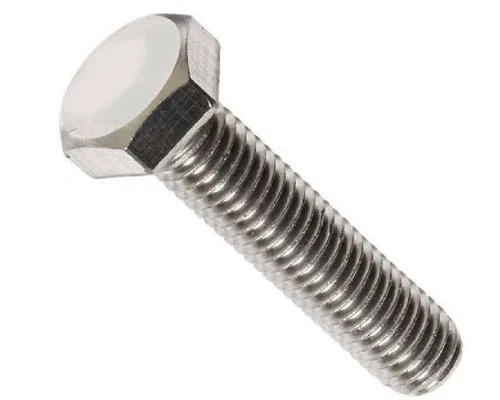
DIN 933: threaded to the head
A full-thread hex bolt (often called a set screw or tap bolt) lets the nut travel the whole length, so it clamps thin parts where a plain shank would bottom out before the nut tightens. It is also the right bolt for a tapped hole in a steel plate or a machine casting, where there is no nut at all and the thread must engage as deep as the hole allows. Clamps, brackets, flanges, rails and anything bolted to a threaded base use DIN 933.
The trade-off is strength under shear: in a bolted joint that tries to slide, the thread sits in the shear plane and the bolt carries the load on its smaller thread core.
DIN 931: a plain shank for the shear plane
A half-thread bolt keeps an unthreaded shank sized to the nominal diameter. Set the length so that shank spans the parts being joined and only the thread sticks out for the nut and washer. The joint then bears on the full shank diameter, which is why structural steelwork, trailer couplings, conveyor frames, pumps and gearbox mounts specify DIN 931 or its ISO 4014 twin.
The thread length on a DIN 931 bolt follows a fixed rule from the standard, so you can check your grip length before you order: twice the diameter plus 6 mm for bolts up to 125 mm long, plus 12 mm from 125 to 200 mm, and plus 25 mm above 200 mm. An M16 x 100 therefore carries 38 mm of thread and 62 mm of plain shank.
How to choose the length
- Add up the grip: every plate, washer and bracket the bolt passes through.
- DIN 931: pick a length whose plain shank covers the grip, leaving thread for the nut plus two to three threads showing past it.
- DIN 933 into a nut: any length that clears the nut by two threads works.
- DIN 933 into a tapped hole: aim for a thread engagement of at least one diameter in steel and one and a half to two diameters in aluminium or cast iron.
Common lengths are stepped in 5 mm up to 50 mm and 10 mm beyond, so round up and add a washer rather than down.
Grade and finish are chosen separately
Either standard comes in property class 8.8 for general engineering, 10.9 where a higher preload is specified, and stainless A2 for damp or visible work; our guide to bolt grades 4.8 to 12.9 explains the numbers. The finish is a third choice: black (plain) for indoor machinery, electro-zinc plated (EPG) for covered steelwork, hot-dip galvanised for the weather, and stainless by the coast, as covered in stainless, zinc-plated or galvanised.
Match the nut and washer to the bolt: a DIN 934 nut of the same class and finish, and a flat washer under the turning part so the clamping face is not scored.
Which one for the job
| Joint | Use | Why |
|---|---|---|
| Steel-to-steel joint that may slide (brackets, frames, couplings) | DIN 931 | Shank in the shear plane; choose length by grip |
| Bolt into a tapped hole, no nut | DIN 933 | Thread engages the full hole depth |
| Thin parts, clamps, slotted rails | DIN 933 | Nut can run right up to the head |
| Flanges with gaskets | DIN 933 | Even clamping across the flange |
| Long bolts above 125 mm in structural work | DIN 931 | Thread length follows the standard, shank carries the load |
Full and half thread hex bolts from our range
This product is a steel hex head bolt with a nominal diameter of M12 and a nominal length of 50. It features a full thread design and a black surface finish. The fastener complies with the DIN 933 standard and carries an 8.8 property class rating.
per Pcs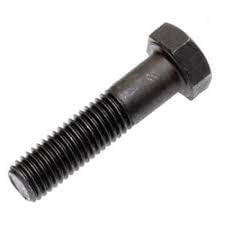
Questions buyers ask
Can I use a DIN 933 full-thread bolt where DIN 931 is specified?
Only if the joint is in tension rather than shear and the engineer agrees. In a sliding joint the thread would carry the load on its smaller core diameter, which is what the half-thread standard is there to avoid.
Is DIN 933 the same as ISO 4017?
For ordering, yes. ISO 4017 and ISO 4014 replaced DIN 933 and DIN 931 with the same head, thread and lengths; most boxes still carry the DIN number, and stockists treat them as one part.
How much bolt should show past the nut?
Two to three full threads. Less and the nut may not be fully engaged; much more wastes length and makes the joint harder to tighten in a tight space.
Do I need a washer under the head and the nut?
A flat washer under whichever part turns during tightening protects the surface and spreads the load. Under the stationary end it is optional; on slotted or soft material use one at both ends.